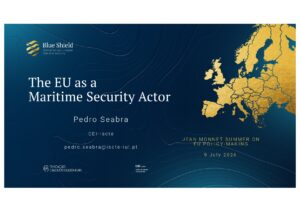
Blue Shield Project in the spotlight at the Jean Monnet Summer School on EU Policy Making
On July 9th, the Blue Shield PI Pedro Seabra participated as a guest speaker of the Jean Monnet Summer School

He is also Director of the Bachelor’s in International Studies and the PhD programme in History, Security Studies and Defence. His research focuses on international relations, international security, maritime security, South Atlantic geopolitics, and security capacity-building in Africa. Alongside his academic work, he previously served as Adviser to the Portuguese Minister of National Defence.
Specialising in International Relations with a focus on energy security, defence, hybrid warfare, and maritime security. Her work combines academic expertise with extensive practical experience across the European security ecosystem, including roles with the Council of Europe and the Organization for Security and Co-operation in Europe. She also contributes to policy, research, and advisory work on the protection of critical infrastructure, resilience strategies, and the defence-energy nexus.
Her work focuses on foreign policy and security studies, with particular expertise in European foreign, security and defence policy, the post-Soviet space, and maritime security in the Atlantic. She previously served as advisor to the Portuguese Minister of National Defence and coordinated the Atlantic Centre between 2021 and 2023.
His academic and professional background combines materials science, defence-related research, and higher education leadership. His work focuses on multifunctional materials, antiballistic protection and armor, and amorphous and ceramic materials. He has also held senior research management responsibilities, including serving as Director of the Hellenic Foundation of Research and Innovation.
She has broad experience in large-scale project management, particularly in investment attraction, regional development, and education. Her work focuses on advancing wind energy development in Latvia, representing the sector’s interests in government and international contexts, and promoting cooperation between companies in the industry. She also works to strengthen public understanding and support for sustainable energy.
His work explores topics such as green monetary policy, climate and environmental risks, biodiversity economics, shadow banking, and green finance. He is particularly interested in how financial systems can support the low-carbon transition and help address broader climate challenges.
Originally from the Netherlands, he previously completed bachelor’s degrees in Global Sustainability Science and History at Utrecht University. His interests focus on the intersection of geopolitics, societal impact, security, and foreign policy.
He is from Finland and holds a bachelor’s degree in International Relations and European Studies from the Metropolitan University of Prague. His academic interests include political discourse analysis, security studies, and foreign policy.
Raised in South Africa, he holds a bachelor's degree in international relations and politics from the University of London. His academic background is rooted in the study of global politics and international affairs.
He is from Canada and holds an Honours Bachelor of Science in Psychology from the University of Toronto. His interests include AI governance and security, emerging technologies, and existential risk management.
From Portugal, he previously completed a bachelor's degree in political science and international Relations at NOVA FCSH. His interests include security and defence studies, diplomacy, and the geopolitics of media.
AI AND DUAL-USE INNOVATION: ADVANCING MARITIME SECURITY IN EUROPEAN HOTSPOTS
Caleb Price
I. EXECUTIVE SUMMARY
Artificial intelligence (AI) is increasingly playing a foundational role in European maritime security. Along with advances in drone, cybersecurity and electronic warfare technologies, AI poses opportunities and challenges for the EU in protecting its blue zones. In this new context, threats to critical infrastructure and the maritime economy arise rapidly.
EU’S BEST PRACTICES IN ENHANCING MARITIME SECURITY
Shawn Rix
I. EXECUTIVE SUMMARY
Best practices are essential to maritime security in the European Union because they help coordinate the actions of diverse member states that may otherwise prioritise different national or organisational approaches. Through frameworks such as the European Union Maritime Security Strategy (EUMSS), the EU strengthens information-sharing, operational coordination, and collective responses to challenges including illegal trafficking in the Mediterranean, piracy affecting European trade routes, cyber threats targeting ports, and risks to critical underwater infrastructure in the Baltic Sea. This is particularly important in a system of shared authority, as it demonstrates how the EU can enhance cooperation while preserving national sovereignty. Furthermore, best practices encourage collaboration with international partners and support the integration of emerging technologies, thereby improving maritime situational awareness and decision-making.
NATO BEST PRACTICES IN ENHANCING EUROPE’S MARITIME SECURITY
Shawn Rix
I. EXECUTIVE SUMMARY
Best practices matter for NATO in maritime security because they ensure member nations operate under shared standards and procedures at sea. This improves coordination in multinational operations, reduces miscommunication, and enables faster responses to threats such as piracy, terrorism, and illegal trafficking. They also strengthen cooperation with NATO partners and support the safe integration of emerging technologies like autonomous systems, advanced surveillance, and cyber capabilities. For Portugal and the Atlantic, NATO best practices are especially important in enhancing Europe’s maritime security by protecting critical Atlantic sea lanes, strengthening surveillance and defence cooperation, and reinforcing Portugal’s strategic role as a gateway between Europe, the Atlantic, and other global maritime routes. By promoting safety, interoperability, and collective defence, NATO best practices help the alliance remain resilient and effective against evolving maritime challenges.
MARITIME SECURITY IN THE BALTIC AND NORTH SEAS: LESSONS LEARNED FOR THE ATLANTIC
Kaarle Ratia
I. EXECUTIVE SUMMARY
Portugal’s maritime security faces a structural challenge. Its Exclusive Economic Zone (EEZ), one of the largest in Europe, cannot be effectively monitored through traditional, presence-based surveillance alone. Atlantic weather conditions and limited human reach create blind spots that are actively exploited. The Portuguese Navy has reported numerous monitoring operations of Russian ships and submarines transiting the Portuguese EEZ, where enforcement authority is limited. Drug cartels operate purposely built semi-submersibles from Latin America, transiting through Portuguese waters mostly undetected. These developments represent a growing threat to both national security and European border integrity. The Baltic and North Sea countries have developed responses to comparable challenges via public-private cooperation that converts commercial assets into dual-use extensions of surveillance, and shared data environments that multiply the reach of national systems. These models were built for the same problems: vast maritime spaces, low resources, and challenges that exploit specific weaknesses. The following selection of examples provides lessons that could translate directly to an Atlantic-based scenario, where Portugal holds a more direct stake from a maritime perspective.
PORTUGAL E O QUADRO POLÍTICO-ESTRATÉGICO EM SEGURANÇA MARÍTIMA
Filipe Ildefonso
I. EXECUTIVE SUMMARY
Portugal é o país mais a sudoeste da Europa, contando com uma linha de costa de 2500 km, contabilizando a costa continental e a das Regiões Autónomas. A sua Zona Económica Exclusiva (ZEE) conta com, aproximadamente 1,7 milhões de km2, sendo a 3ª maior da União Europeia (UE) e a 20ª maior do mundo, tornando este território marinho cerca de 18 a 19 vezes superior à área territorial de Portugal. Tendo em conta o crescendo de insegurança no palco internacional, bem como o quadro das parcerias europeias em que se insere, urge uma sistematização dos objetivos e prioridades estabelecidos ao nível da segurança marítima.
On July 9th, the Blue Shield PI Pedro Seabra participated as a guest speaker of the Jean Monnet Summer School
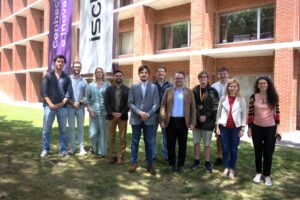
On June 2nd, the Blue Shield project team gathered at Iscte – University Institute of Lisbon for an internal working
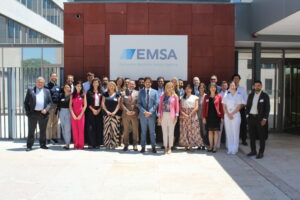
On June 1, the Blue Shield project—Strengthening European Maritime Security, funded by the Calouste Gulbenkian Foundation and carried out at

As one the key expected outputs, the Blue Shield project will organize an interdisciplinary workshop on June 1st in Lisbon,
Blue Shield Coordinator, Pedro Seabra, participated in the podcast “90 segundos de Ciência” (in Portuguese), where he presented the project